

Code of Conduct
STATEMENT OF PURPOSE
At Erma Stephenson, we believe that all children have the right to learn in a safe, caring and orderly environment. Our expectations are that students will maintain an attitude that is cooperative, courteous and respectful. Students are expected to follow the guidelines outlined in the Code of Conduct in classrooms, in the school building, on school grounds, and at school functions, regardless of their location. Every Student receives a copy of the Code of Conduct. Teachers review expectations on an ongoing basis. The staff assists students in developing skills for resolving conflict, problem solving and decision making appropriate to their age for healthy learning and living. The school will notify parents of any serious breaches of the code of conduct.
Respect for Learning - caring about your own learning and the learning of others.
Some examples include:
- allow others to work without distractions
- be prepared with materials
- take responsibility for your learning
- make good, safe choices
- be on time and ready to work
- be a good listener
Respect for Others - being considerate of others’ personal feelings and property, treat others the way you would like to be treated.
Some examples include:
- be polite and use your manners
- treat others with respect, be kind (to peers and adults)
- cooperate and share
- be honest and tell the truth
- keeps hands and feet to self
Respect for Ourselves - caring about the type of person you want to be.
Some examples include:
- be on task
- use manners, polite language
- clean up after yourself
- have a positive attitude
- use time wisely
Respect for our School - caring about your school and your environment
Some examples include:
- take good care of materials and equipment/personal belongings
- keeps hands off walls and displays
- play in designated areas
- use garbage cans, recycle
BEHAVIOUR EXPECTATIONS
Acceptable and unacceptable behavior while at school, attending school related activities (both on and off school grounds) or in any other circumstances where engaging in the activity will have an impact on the school environment. There will be rising expectations of behaviour as students mature.
It is important to note that the acceptable and unacceptable behaviours that follow are not all-inclusive lists.
Acceptable Behaviour:
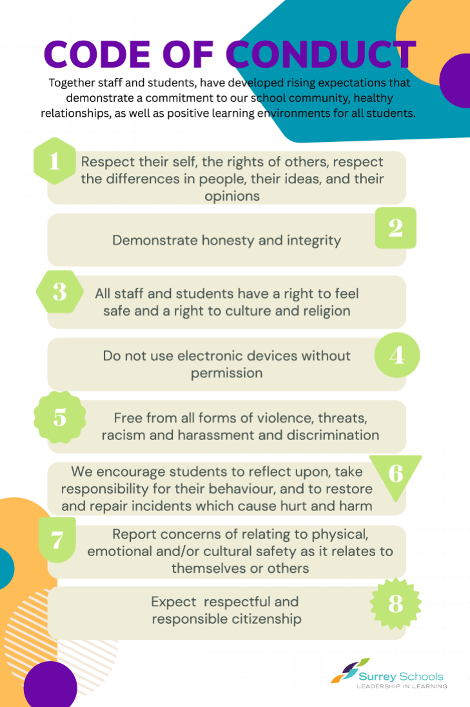
THE ERMA STEPHENSON CODE OF CONDUCT includes: • Respect for LEARNING • Respect for OURSELVES • Respect OTHERS • Respect for our SCHOOL
|
SAFE & CARING SCHOOLS: ARE FREE FROM ACTS OF:
- Bullying (including cyber-bullying)
- Harassment, threat, intimidation and marginalization
- Violence in any form
- Abuse in any form (verbal, physical, sexual)
- Intolerance and discrimination in any form, i.e. based on an individual or group’s race, colour, ancestry, place of origin, political belief, religion, marital status, family status, physical or mental disability, sex, sexual orientation, or age.
- Retribution against a person who has reported incidents
DO NOT TOLERATE THE PRESENCE OF:
- Intoxicating or banned substances (including alcohol, cigarettes and drugs)
- Theft and vandalism (or damage to personal property)
- Weapons or replica (toy) weapons (including laser pointers); explosives (including fireworks) and pepper or other obnoxious sprays.
- Intruders or trespassers (all visitors must first report to the office)
- Inappropriate clothing or unacceptable slogans imprinted on clothing
MISUSE OF ELECTRONIC DEVICES/COMPUTERS:
- School computers and other electronic devices are only to be used for school/education related activities. They are not permitted for social networking, gaming, illegal, obscene or inappropriate purposes. Inappropriate use includes, but is not limited to, attempts to vandalize, gain unauthorized access to data or another person’s account or resources, and sharing of data without personal or parental consent as appropriate.
- Recording of visual images is not permissible at school unless permission has been received by the classroom teacher with respect to a classroom project.
- Students are to be aware that they may be subject to discipline (or, if applicable, confiscation of personal property) for misuse of any technology, if it negatively impacts the school environment.
- Misuse of district technology services will lead to suspension of user privileges and possible disciplinary or legal action.
PERSONAL DIGITAL DEVICES
- are defined as any personal electronic device that can be used to communicate or to access the internet, such as a cell phone, tablet, laptop, or smartwatch. These devices are important tools which can be used to enhance learning and prepare children for the world in which they will work and live. Personal digital devices provide support for children who rely on these tools to access learning through services such as translation, adaptations for Individual Education Plans, medical support, health needs, or to provide equity of access to resources. The classroom teacher is responsible for the learning environment in the classroom, for guiding children to use personal digital devices appropriately, and for determining when personal digital devices should be used.
- The safe and responsible use of personal digital devices is expected by all Surrey School District students, employees, volunteers, parents, guardians, and community members who are on school district property or interacting with students or staff. This includes the following:
- Those using personal digital devices need to abide by the school code of conduct as well as all Provincial and Federal laws and the British Columbia Human Rights Code. This includes not using personal digital devices to engage or participate in bullying or harassment, discrimination, or defamation of character.
- At both elementary and secondary schools, personal digital devices can be used during class time to enhance learning at the direction of the classroom teacher. These devices should be used in a way that is respectful of other’s learning and does not distract others in terms of light, sound, or by other means.
- At elementary schools, it is expected that personal digital devices are to be put away during non-class time such as recess and lunch. Exceptions to this are for students who need digital devices for medical or health reasons, translation, accessibility, or other student-specific reasons.
- Personal Digital Devices should not be used during lock down procedures or drills. The use of personal digital devices during this time may impact the emergency safety response.
- Surrey School District staff and students should not be recorded, visually or audibly, for any reason without their prior consent.
- The Surrey School District is not responsible for lost, missing, or damaged personal digital devices that students choose to bring to school.
CONSEQUENCES
Consequences will take into account the age, maturity and special needs (e.g. intellectual, physical, sensory, emotional or behavioural challenges), severity and frequency of actions. Consequences will be progressive and will focus on being restorative rather than punitive in nature. Depending upon these and other factors, one or more of the following actions may be taken:
- Verbal warning
- In-school suspension
- Problem solving discussion
- Out of school suspension
- Time-out
- Problem Solving sheet
- Recess/Lunch restriction
- School/Community service
- Parent contact/meeting
- Referral for Counselling or behaviour support
NOTIFICATION:
School administration will advise parties as follows:
- Parent/guardian of student exhibiting major behavior problem - every instance.
- Parent/guardian of student on the receiving end of an incident - every instance.
- Assistant Superintendent, Safe Schools Department and/or other District Staff – as needed
- Ministerial agencies and/or School Liaison Officer (RCMP) – as needed
